Integrally finned copper tube
For specified heat-exchanger designs, integral fins are formed from the tube material rather than attached separately.
Review fin geometry →
Heat-transfer components for exchangers
Finned Tube increases the available surface area of a base tube for specified heat-transfer duties. Therefore, send S.K. Metal the tube material, outside diameter, wall thickness, fin geometry, plain-end length and quantity before ordering.
Product overview
For example, S.K. Metal reviews enquiries for condensers, evaporators and chillers against the specified thermal and mechanical design.
Compared with a plain tube of similar length, fins increase external area. Consequently, a designer can pursue the required heat-transfer duty within a specified exchanger arrangement. However, performance also depends on fluid properties, airflow, fin spacing and operating conditions. Therefore, provide the approved drawing rather than selecting solely by tube diameter.
See the enquiry checklist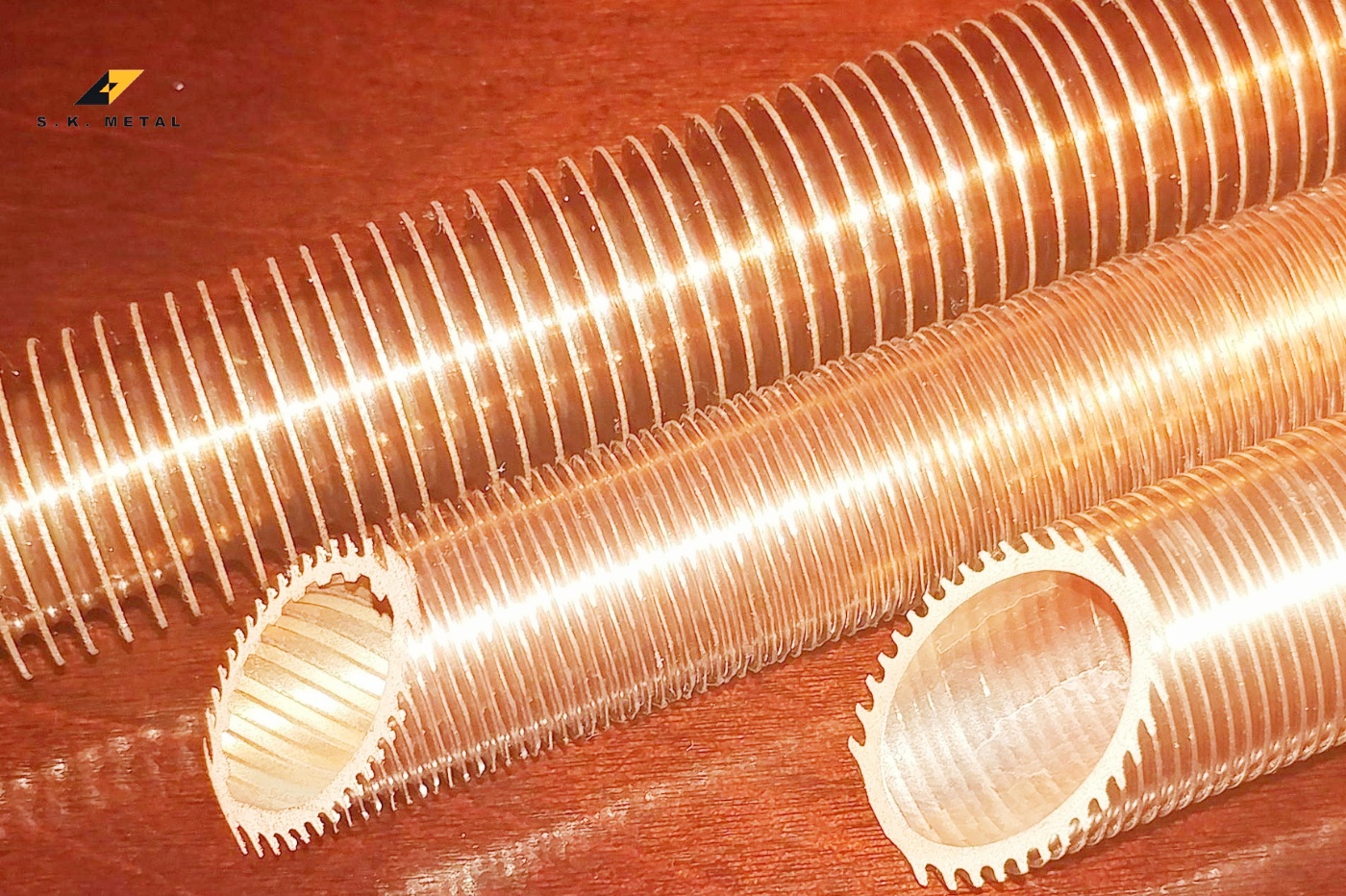
Types and configurations
First, confirm the exchanger drawing and operating duty. After that, identify the tube alloy, fin profile, fin density and plain-end requirements.
For specified heat-exchanger designs, integral fins are formed from the tube material rather than attached separately.
Review fin geometry →In addition, straight lengths can be ordered to match the exchanger layout, subject to available dimensions.
Discuss length options →Where joints need an un-finned area, specify the required plain length at each end.
Provide end lengths →Moreover, a drawing may call for skipped fin sections to clear baffles or supports.
Review landing positions →For certain duties, cupro-nickel or other alloys may be specified instead of copper; confirm availability.
Review material needs →Finally, repeat orders can follow an approved fin drawing, tube standard and inspection plan.
Send your tube drawing →Specification guide
As a result, a complete drawing helps prevent errors in base tube dimensions, fin geometry and exchanger fit.
Important: Do not select a finned tube by base OD alone. Instead, obtain approval for fin pitch, height, material, plain lands, operating duty and exchanger geometry.
Applications
Because thermal duties differ, each tube and exchanger design must be matched to the operating conditions.
For example, fins can provide additional surface area in a specified condenser layout.
Moreover, the fin profile and pitch are selected for the evaporation duty.
In addition, integrally finned tubes may be specified for particular chiller heat exchangers.
Where the cooler design calls for fins, confirm fluid and pressure conditions.
However, a replacement tube should match the approved exchanger drawing.
Therefore, repeat purchases should follow an approved tube schedule and inspection plan.
Quality and documentation
Before ordering, confirm base tube dimensions, alloy, fin profile, fin pitch and plain-end lengths. For general copper tube and joining guidance, buyers can also review the Copper Tube Handbook.
Discuss your material requirement →Ordering checklist
For an accurate quotation, first send the tube drawing, material, fin dimensions, length, quantity and delivery details.
First, state the equipment type, working fluids and operating conditions.
Next, provide base tube OD, wall, alloy and overall length.
Then identify fin density, height, profile and tolerances.
In addition, state plain-end and intermediate landing positions.
Finally, include quantity, destination, schedule and requested documents.
Frequently asked questions
In simple terms, it is a tube with fins that increase available external surface area. As a result, it can support a specified heat-transfer design.
Fin density describes the number of fins over a given length, often expressed as fins per inch. However, the required density must follow the approved exchanger drawing.
Yes, the existing S.K. Metal range describes straight tubes with plain ends. Therefore, specify the required plain length on each side when requesting a quote.
They are un-finned sections placed along a tube, for example where exchanger baffles or supports require clearance.
For a useful quote, provide base tube OD, wall, material, fin pitch, fin height, total length, plain sections and quantity.
Yes, subject to availability by order. In addition, list material, dimensional and traceability documents when requesting a quote.
Request a quotation
To begin, include material, base OD, wall, fin density, fin height, plain-end length, total length, quantity and delivery location. Afterward, S.K. Metal will review the enquiry.
Send your requirement