Full copper crossover
First of all, a full crossover routes one continuous tube path over another line or obstruction.
Review specification details →
Formed copper fittings for compact piping routes
First of all, source Copper Cross Over fittings by tube outside diameter, wall thickness, crossover height, offset, end geometry, quantity and approved drawing for HVAC and refrigeration piping.
Product overview
In addition, S K Metal supplies formed copper crossover components for buyers who need one tube path to pass another within a controlled installation envelope.
A crossover must match the adjoining copper tube as well as the required rise, offset, bend radii and end alignment. However, appearance alone cannot confirm fit. Therefore, buyers should provide an approved drawing, sample or complete dimensional schedule before ordering.
See what to include in your crossover enquiry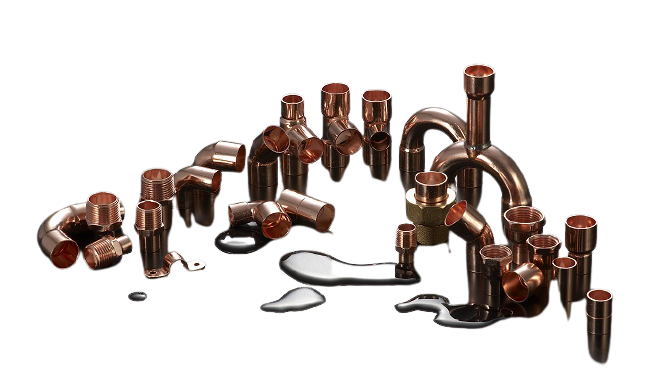
Configurations and geometry
First, confirm the route and connection points. Then verify tube OD, wall, crossover height, offset and end alignment.
First of all, a full crossover routes one continuous tube path over another line or obstruction.
Review specification details →In addition, a partial crossover can provide a controlled offset where the adjoining layout completes the route.
Send the required geometry →However, equal-size components still require confirmation of OD, wall thickness, centreline and end alignment.
Check dimensional feasibility →Moreover, transitions between different connection sizes should be produced only from an approved dimensional drawing.
Send your size schedule →Furthermore, drawing-based shapes can be reviewed for OEM, coil and compact equipment assemblies.
Discuss a custom component →Finally, repeat assemblies may include specified end preparation, orientation and identification requirements.
Send assembly details →Specification guide
Therefore, a complete drawing helps prevent errors in tube size, height, offset, bend radius and connection alignment.
Important: Do not manufacture or select a crossover from a photograph alone. Therefore, the system designer should approve the final drawing, material, dimensions and joining details before production.
Applications
Because layouts differ, the correct crossover depends on available space, adjoining tube dimensions and system conditions.
For example, a crossover can route compatible copper lines within a constrained indoor or outdoor unit assembly.
Moreover, formed crossover components may support approved refrigerant branch and equipment layouts.
In addition, compact cooling assemblies can use formed tubes where one connection must pass another.
Furthermore, crossovers can connect or route tubes around headers, returns and adjacent coil components.
However, repeat OEM parts require controlled tooling, drawings, tolerances and sample approval.
Therefore, project-specific components should be reviewed against the complete assembly rather than in isolation.
Quality and documentation
Before ordering, define the dimensional checks and documents required for the exact component. In addition, designers can review the Copper Tube Handbook for general information about copper tube properties, joining and system considerations.
Discuss your material requirement →Ordering checklist
For an accurate quotation, send an approved drawing or sample together with the complete tube and operating specification.
First of all, include all connection, centreline, bend, height, offset and orientation dimensions.
Next, provide OD, wall thickness, grade, temper and tolerances in one consistent unit.
Then list plain, expanded, swaged or other end forms and required insertion depths.
In addition, state medium, pressure, temperature, joining method and equipment reference.
Finally, include pieces, sample approval, packaging, destination, schedule and documentation.
Frequently asked questions
In general, it is a formed copper component that allows one tube route to pass over or around another line or obstruction.
For an accurate quotation, provide every connection OD, wall, overall size, crossover height, offset, bend radius, centreline and end dimension.
Yes, a sample may support review. However, an approved production drawing should still define material, dimensions, tolerances and acceptance criteria.
Availability depends on the required size transition and geometry. Therefore, submit a drawing and quantity for feasibility review.
The approved joining method depends on end geometry and the system specification. Consequently, state brazing, soldering or other connection requirements in the enquiry.
Yes, but availability varies by order. Finally, list material, dimensional, inspection and traceability requirements before quotation.
Request a quotation
To begin, include tube sizes, wall thickness, complete geometry, ends, material, service and delivery location. Afterward, S K Metal will review manufacturability and quotation details.
Send your requirement