Copper Y joint
First of all, a Y-shaped fitting divides or combines a compatible route through two angled branches.
Review specification details →
Copper branch fittings for refrigerant distribution
First of all, source Copper Tripods / Y Joints by inlet size, outlet sizes, branch angles, wall thickness, end preparation, system specification and quantity.
Product overview
In addition, S K Metal supplies formed copper branch fittings for compatible air-conditioning, refrigeration and equipment piping layouts.
Moreover, each assembly must match the inlet, every outlet, branch angle, wall thickness, end geometry and approved system arrangement. However, similar-looking Y joints may have different capacity or dimensional requirements. Therefore, buyers should provide the equipment schedule, approved drawing or complete branch specification before ordering.
See what to include in your Y-joint enquiry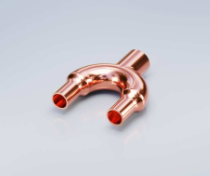
Types and configurations
First of all, confirm the number of outlets and the approved branch layout. Then verify every tube size, angle, leg length and end form.
First of all, a Y-shaped fitting divides or combines a compatible route through two angled branches.
Review specification details →In addition, a tripod-style assembly provides multiple connection legs arranged to an approved geometry.
Provide every connection size →However, different outlet sizes must be identified separately and matched to the specified system layout.
Define the outlet sizes →Moreover, expanded ends must be defined by mating OD, insertion depth, clearance and joining method.
Request dimensional review →Furthermore, HVAC enquiries should identify equipment reference, refrigerant service and cleanliness requirements.
Discuss system requirements →Finally, drawing-based inlet, outlet, angle, leg and end details can be reviewed for project requirements.
Upload a dimensional drawing →Specification guide
Therefore, a complete specification helps prevent errors in inlet size, outlet sizes, branch geometry, orientation and joining requirements.
Important: Do not select a branch joint from one nominal size alone. Therefore, the system designer should approve every connection, branch angle, material, rating and joining procedure.
Applications
Because systems differ, the correct joint depends on every connection size, branch layout, joining method and operating conditions.
For example, compatible Y joints create planned branches in an approved refrigerant piping layout.
Moreover, specified branch joints can divide or combine compatible routes in multi-split networks.
In addition, approved distributors can route refrigerant lines toward multiple indoor units.
Furthermore, branch components must match the equipment maker's layout and capacity requirements.
However, factory assemblies may need drawing-controlled branch angles, legs and end dimensions.
Therefore, repeat components should be approved by drawing, sample, tolerance and inspection criteria.
Quality and documentation
Before ordering, define the inlet, outlets, branch angles, leg lengths, wall and orientation checks required for Copper Tripods / Y Joints. In addition, designers can review the Copper Tube Handbook for general information about copper tube and joining practices.
Discuss your material requirement →Ordering checklist
For an accurate quotation, send the fitting schedule or drawing together with the complete tube and service specification.
First of all, state Y joint, tripod, reducing branch or drawing-based configuration.
Next, provide inlet and outlet ODs, walls, angles, leg lengths, centreline dimensions and tolerances.
Then list socket, expanded, swaged or other end forms, insertion depths and joining clearances.
In addition, state medium, pressure, temperature, joining method and equipment reference.
Finally, include pieces, sample approval, packaging, destination, schedule and documentation.
Frequently asked questions
In general, they divide or combine compatible tube routes through an approved branch geometry. Every inlet and outlet must match the system specification.
In addition, provide every connection OD and wall, branch angles, leg lengths, socket depths, overall dimensions and tolerances.
A standard tee commonly forms a perpendicular branch. However, a Y joint uses angled branches and must follow the approved routing geometry.
However, availability depends on every connection size, branch geometry, wall and quantity. Therefore, submit the complete schedule or drawing.
In general, the approved method depends on end geometry and system specification. Consequently, state brazing or another required joining procedure.
Yes, but availability varies by order. Therefore, list material, dimensional, inspection and traceability requirements before quotation.
Request a quotation
To begin, include inlet and outlet sizes, walls, branch angles, leg lengths, ends, equipment reference, quantity and delivery location. Afterward, S K Metal will review availability and quotation details.
Send your requirement